
Why do your efforts to improve performance and results fail?
Only 12% of efforts to improve company performance are completed on time, on budget, and deliver the ROI you expected. The cause is not what most leaders think.
The problem is not the plan. It's human behavior.
Not understanding how human behavior actually works creates failed initiatives, performance below expectations, ineffective leadership, and hiring mistakes.
Most companies never see this.
You are not alone.
Most company leaders know their companies should be delivering better results and a better return on their investment, but they're doing the best they can with what they know.
And every effort that stalls, runs over budget, or misses its ROI is expensive. It's frustrating. And it chips away at your leadership credibility.
- Stalled Momentum stops before the finish line.
- Abandoned Shelved because of resistance.
- Late Timelines slip past the plan.
- Over budget Costs run past what was approved.
- No ROI Results fall short of the business case.
What's the solution?
Adopt one guiding principle.
Use this principle from Human Behavior Science to systematically:
- Improve employee performance An excellent performer is 4 times more productive than an average performer. That improvement directly improves the bottom line.
- Help employees embrace the changes your company needs to make Moving from resisting change (the normal human response) to embracing change is a predictable process. Leaders who understand it help employees get there faster.
- Put the right people in the right seats Teach leaders how human behavior works, so every employee is playing to their strengths.
- Make better hiring decisions and avoid hiring mistakes Interview using the Human Behavior Science factors most predictive of on-the-job performance. You're looking for top 4X performers, not 1X performers who will drag others down to their level.
4× More productive – a high performer against an average one McKinsey & Company – study of 600,000+ researchers, entertainers, politicians and athletes
This is the same principle the Oakland A's used to create Moneyball.
In 2002, the A's payroll was about one-third of the New York Yankees'. The A's still won 103 games, tied for the most wins in baseball. How did they do that?
They found factors that were far more effective at winning baseball games than batting average and RBIs, with one-third the salary expense. Their ROI went up dramatically.
Now it's your turn. Human Behavior Science reveals the factors that predict employee, team, leader, and company performance better than the factors most companies use today.
You're already working full-time to achieve the best results possible.
Today, you fix problems one at a time; one hole in the dike after another.
With Human Behavior Science, you fix the root cause of your employee performance challenges.
Same effort. Record-setting results.
10% Increase in top performance
23% Higher operating profit Gallup – Q12 meta-analysis, 2020
That’s how you set records. And how you become the company the rest of your industry measures itself against.
Want to see the math and the client results? Just ask.
Human behavior is highly predictable. That's the competitive advantage you can build.
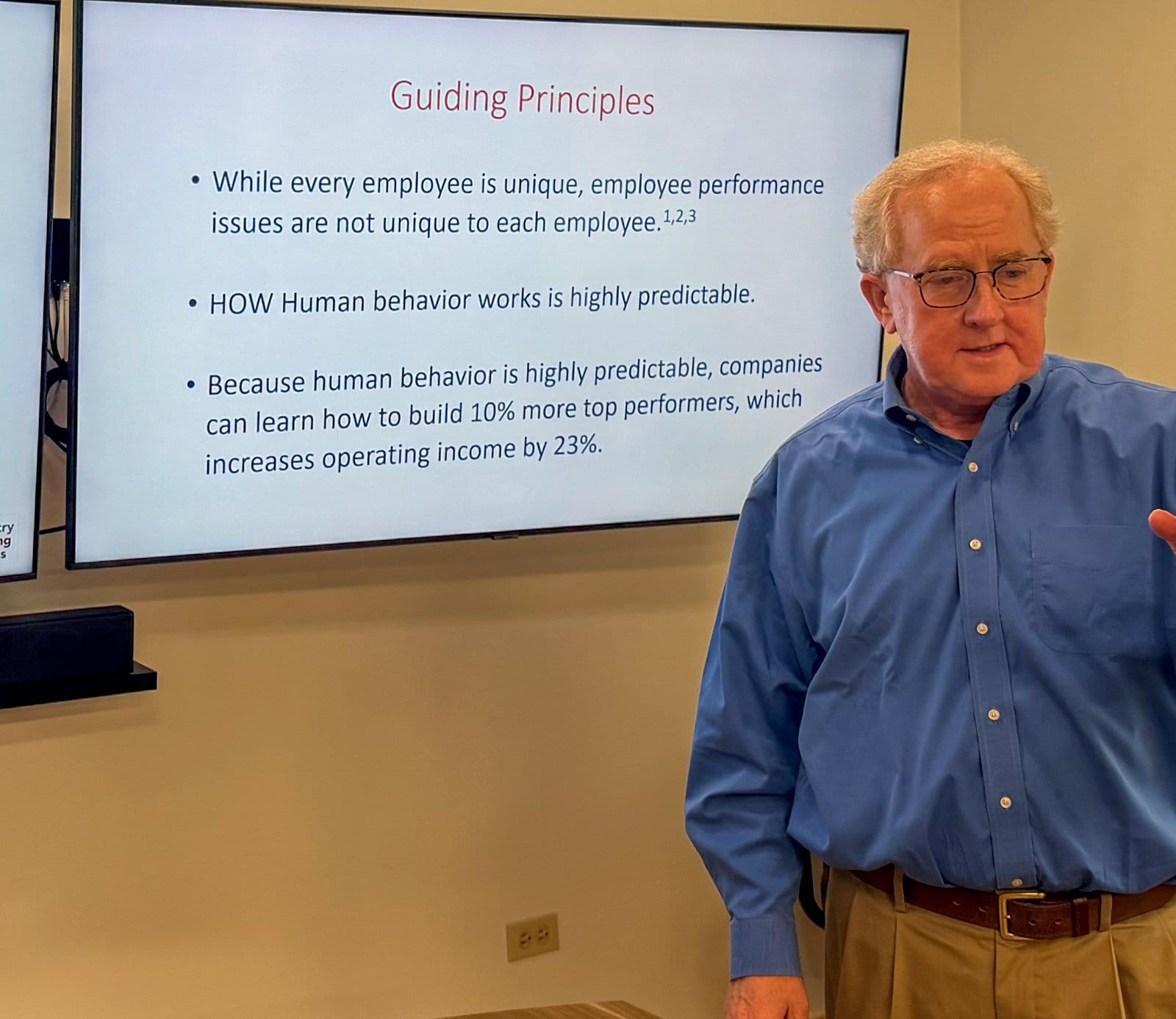
I help individuals and companies unlock overlooked opportunities to achieve results that they don't yet see are possible, using Human Behavior Science. Think Moneyball.
Predictable behavior means employee, team, leader and company performance isn't a mystery. It can be guided.
I use 30+ "Moneyball"-style tools in my consulting work, and I developed more than 15 of them myself. When performance improves, financial results follow.
Sources
- Mankins, M., & Litre, P. (2024). Transformations that work. Bain & Company. Harvard Business Review.
- Keller, S., & Meaney, M. (2017). Attracting and retaining the right talent. McKinsey & Company.
- O'Boyle, E., Jr., & Aguinis, H. (2012). The best and the rest: Revisiting the norm of normality of individual performance. Personnel Psychology, 65(1), 79–119.
- Harter, J. K., Schmidt, F. L., Agrawal, S., Blue, A., Plowman, S. K., Josh, P., & Asplund, J. (2020). The relationship between engagement at work and organizational outcomes: 2020 Q12® meta-analysis (10th ed.). Gallup.
Let’s talk.
Ready to talk it through?
Book a quick callor email jim@industryleadingresults.com
Human Behavior Science. The edge your competitors have overlooked. So far.